Thinking Tools · Rev A · Inspection tag

The limit was inherited.

Many of the limits we work under were set for a tool, a cost, or a constraint that may not exist anymore. Six old ideas for checking the rules instead of obeying them. It matters most now, because AI changes what is cheap, fast, and possible, and old rules quietly hold you back.

Dark steel title card: The limit was inherited. Six thinking tools for auditing the rules you never chose. A dimension line labeled TOO BIG ± ? sits beside an inspection tag for the rule Keep the CSS file small, asking: still true?

A shop story you already know

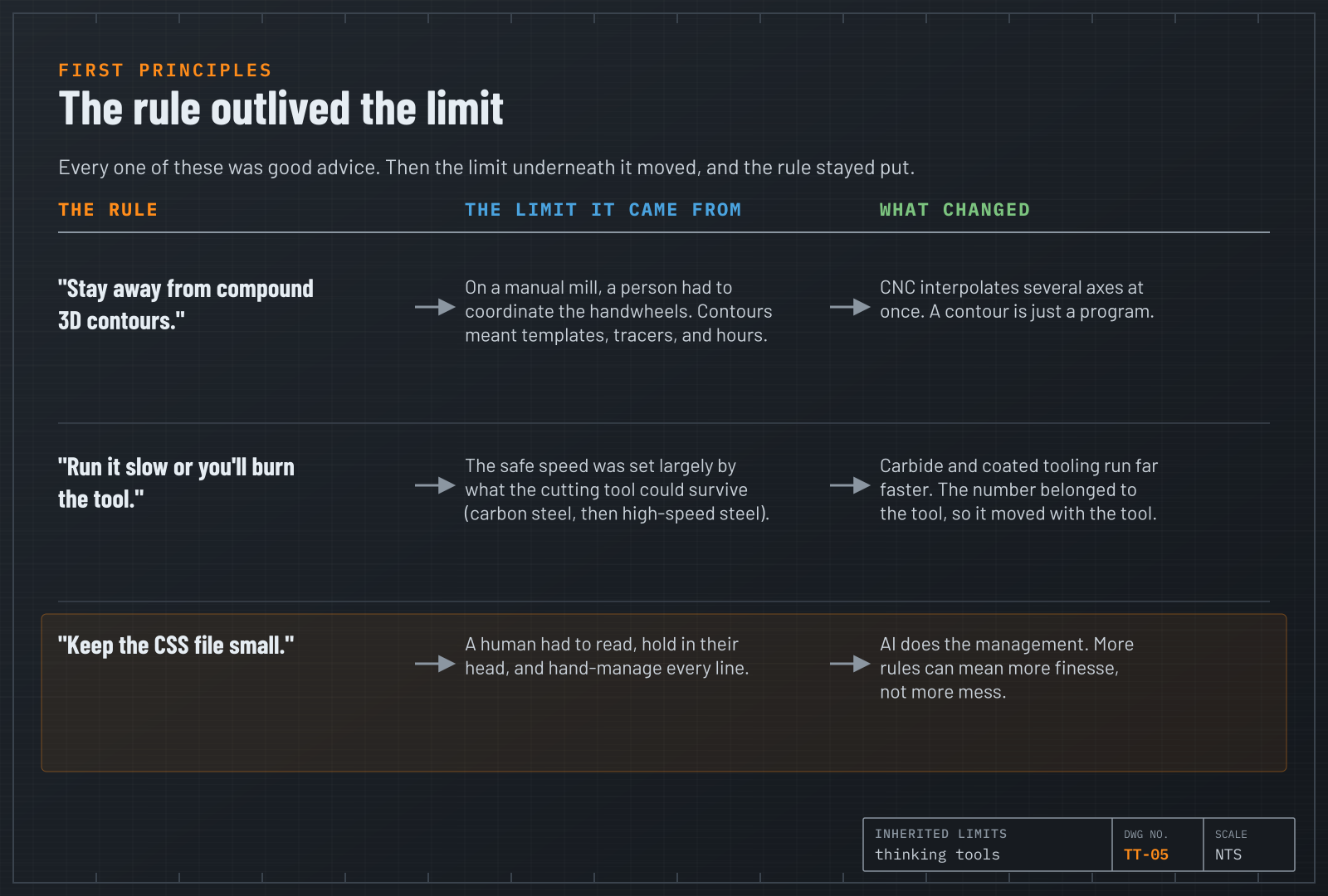
Old speeds-and-feeds rules of thumb were mostly about what the cutting tool could survive. Carbon-steel tools couldn't take the heat, so you ran slow. High-speed steel let shops cut much faster. Carbide pushed it further.

The metal didn't change. The tool changed, and the right number moved with it.

The guy who learned on carbon steel and kept running carbide at his old speeds isn't being careful. He's leaving most of the machine on the table, and calling it craftsmanship.
RULESTILL TRUE? CHECK IT

For each idea below: watch the video, read the article, then do the exercise. The exercise is where it sticks.
01

Systems Thinking

Who’s who  /  Meadows · Forrester · Bertalanffy

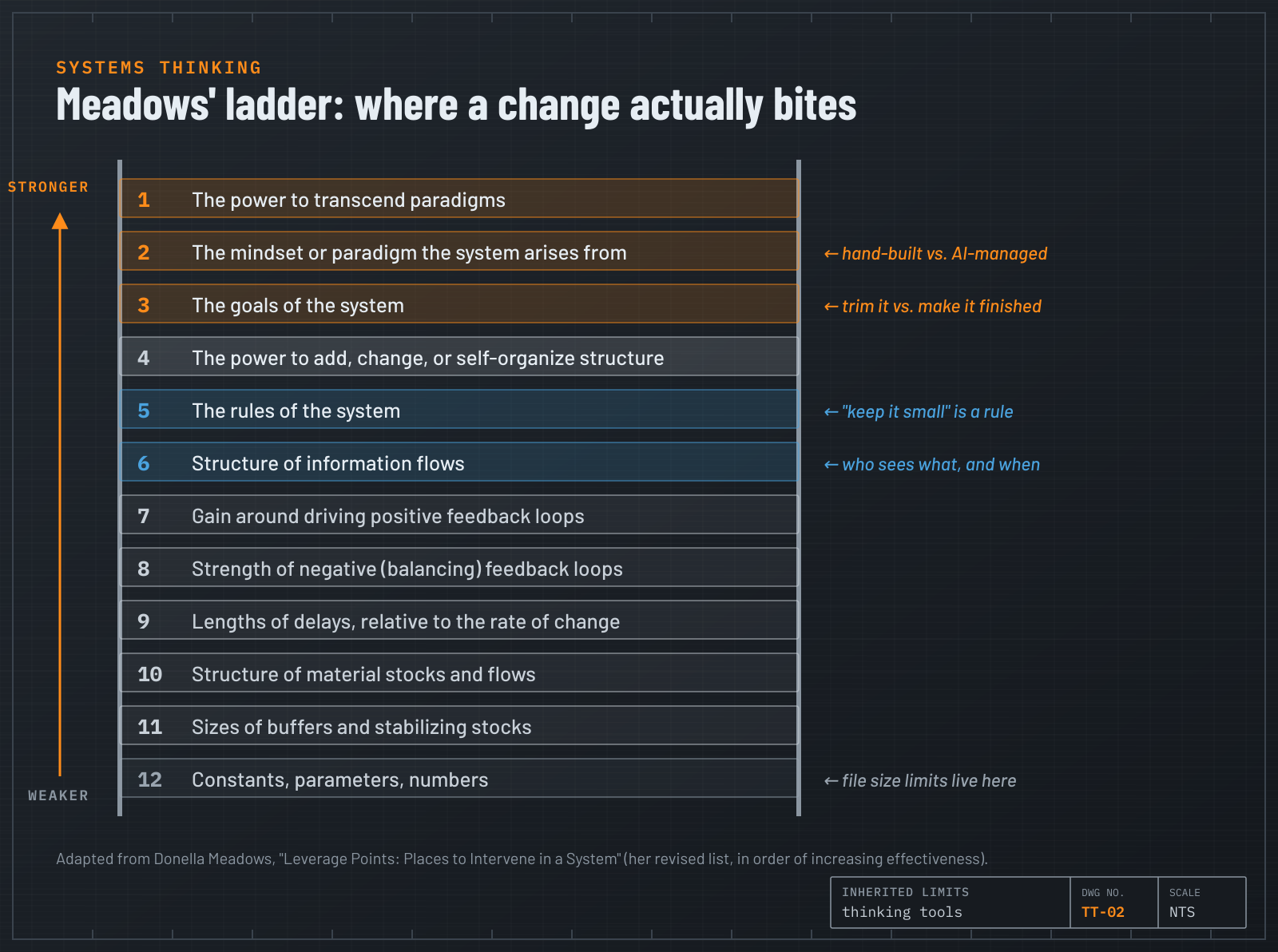
Look at how the parts connect and feed back on each other. The connections and rules usually matter more than the parts. Meadows ranks mindset and goals as the strongest levers, and tweaking numbers as the weakest.

A ladder of Donella Meadows' twelve leverage points, weakest at the bottom (constants and numbers) and strongest at the top (mindset and goals).
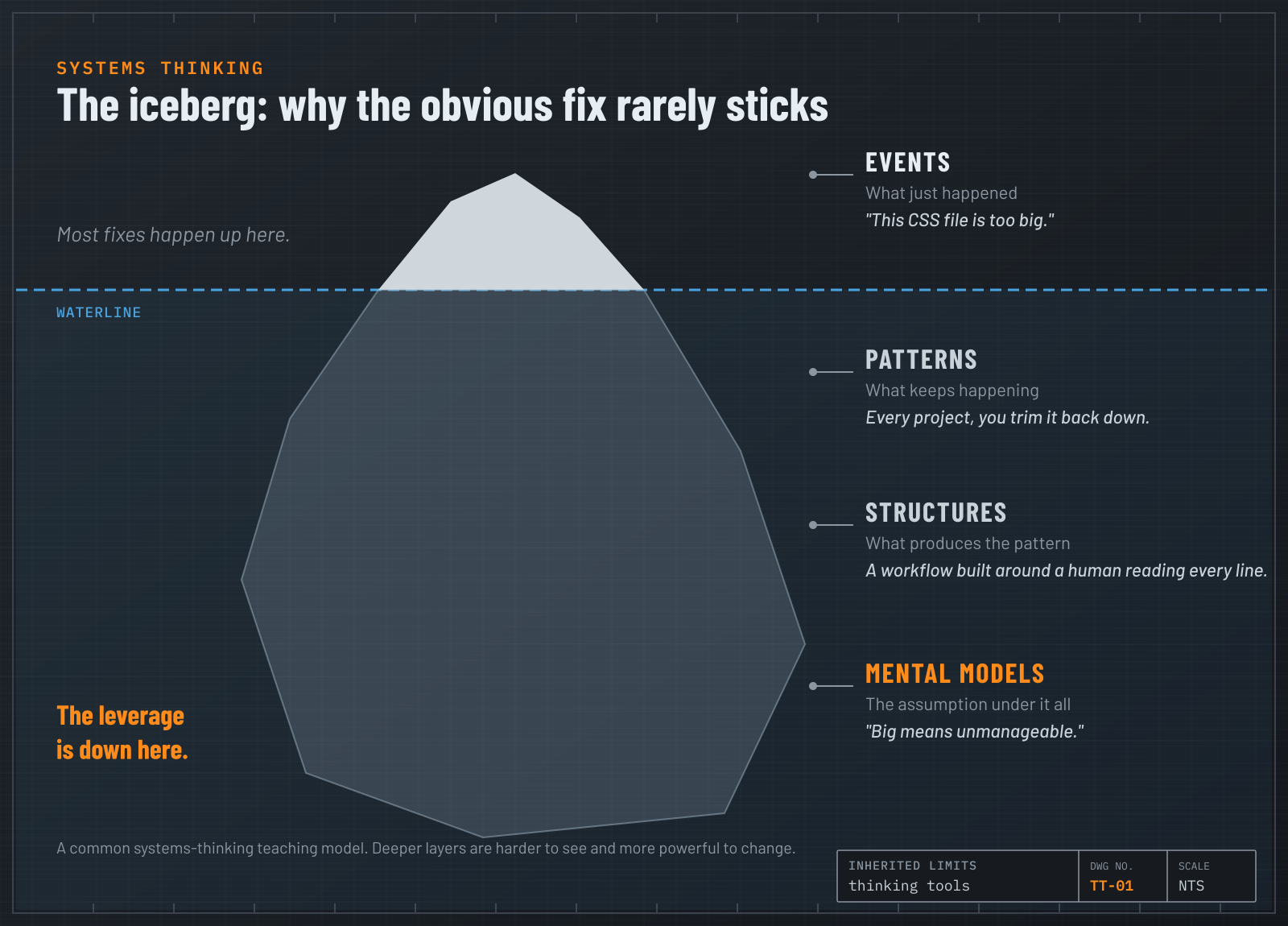
Iceberg diagram: events above the waterline; patterns, structures and mental models below it.
EXERCISE20 min

Pick one project. Draw 5 to 8 boxes for its parts and arrows for what affects what. Circle one arrow that loops back on itself. Ask: which rule here would change the most if I dropped it?

02

First Principles

Who’s who  /  Aristotle → Descartes → every good engineer

Break a problem down to what you know is true, then build up, instead of copying how it has always been done. Ask what actually limits the result today.

EXERCISE15 min

Write down one “that's just how it's done” rule from your work. Why was it made? Who was it for? Is that reason still true? What would you do starting from zero?

03

Double-Loop Learning

Who’s who  /  Chris Argyris

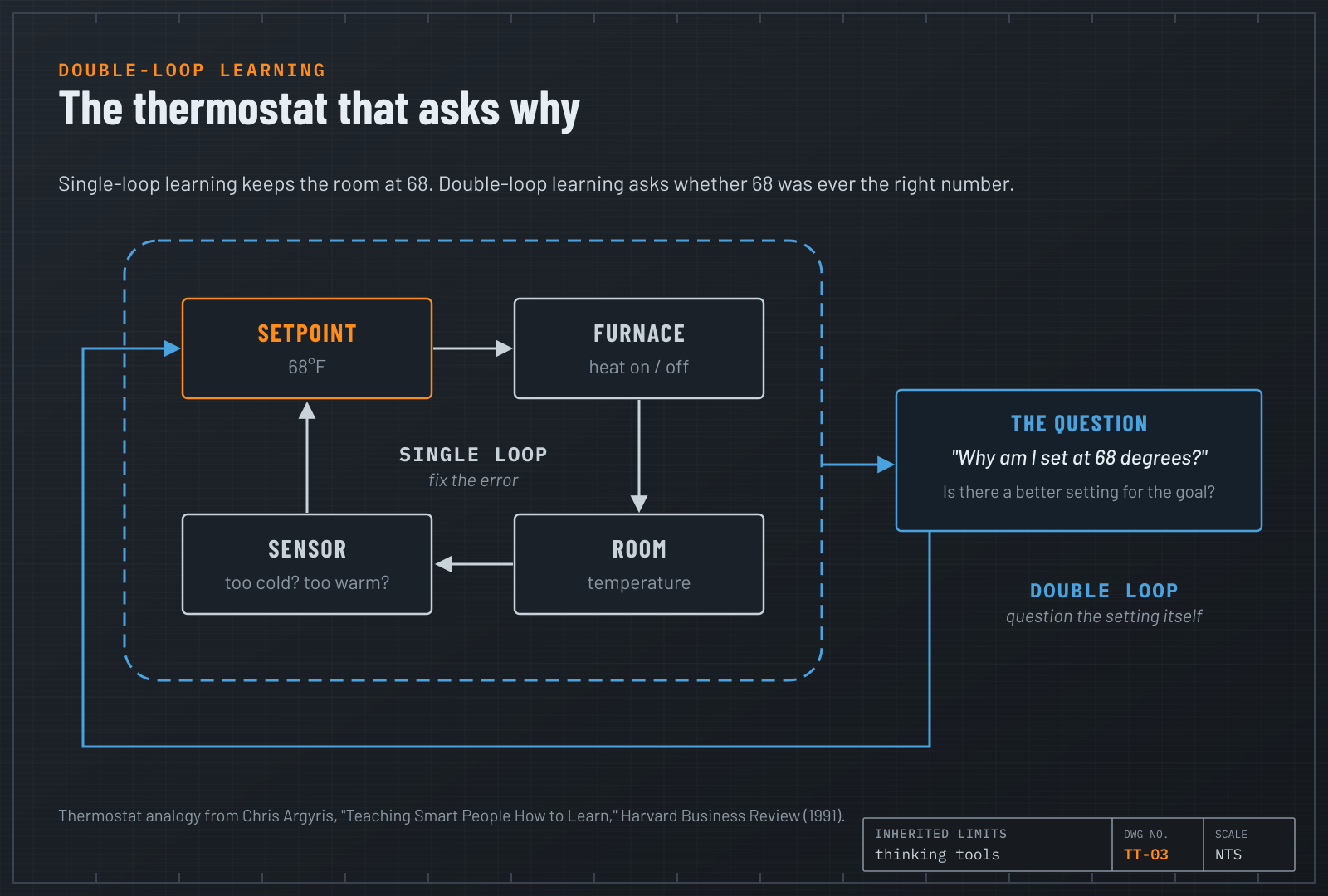
Single-loop learning fixes the mistake. Double-loop asks whether the rule behind the mistake is wrong. A thermostat that holds 68 is single-loop. Asking “why 68?” is double-loop. Argyris found that smart, successful people are often worse at this, because they rarely fail and get defensive.

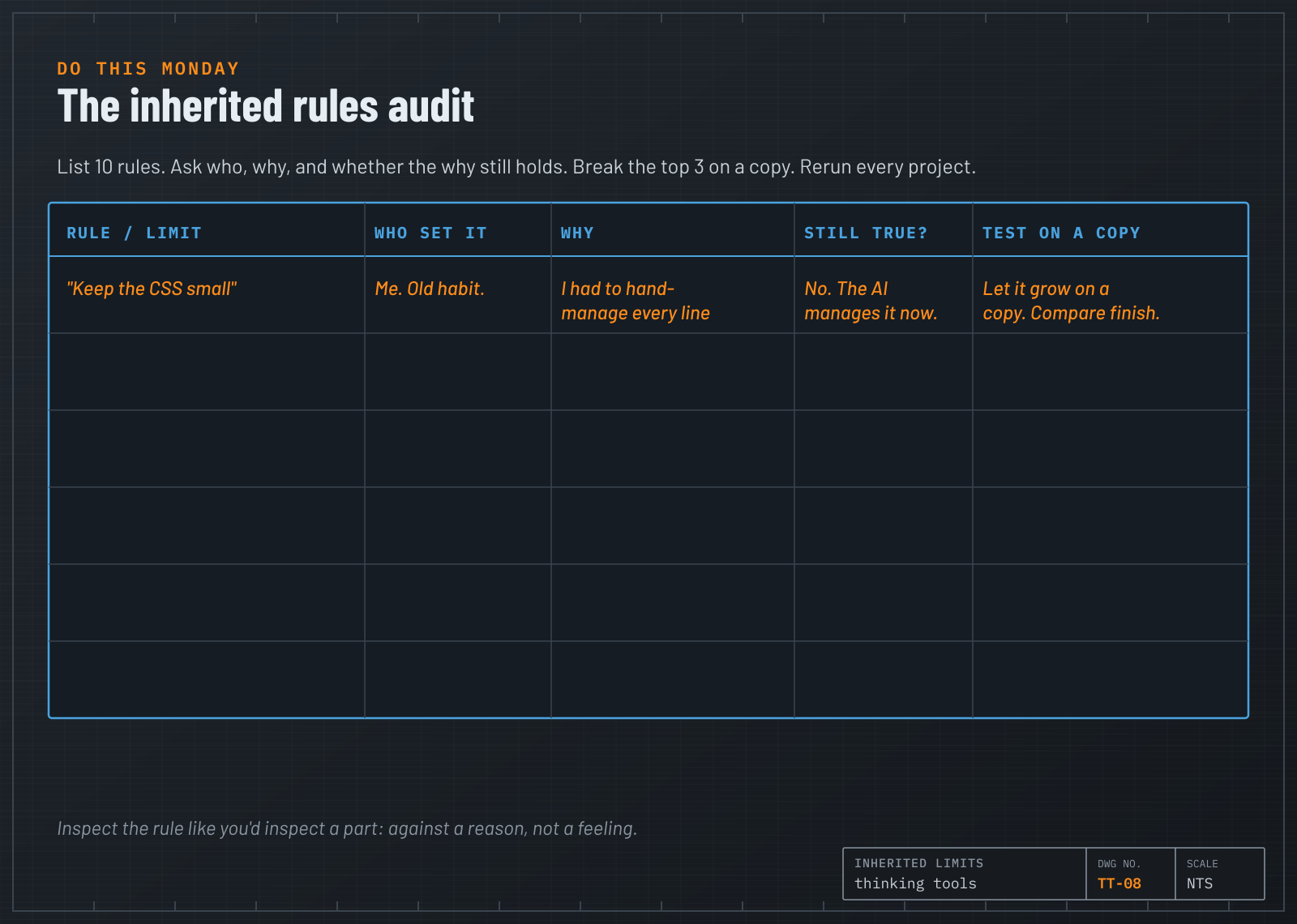
EXERCISE30 min · the inherited rules audit

List 10 rules or limits in a current project. For each, write who set it, why, and whether that reason still holds. Test the top 3 by breaking the rule on a copy and seeing what happens.

04

Paradigm Shifts

Who’s who  /  Thomas Kuhn

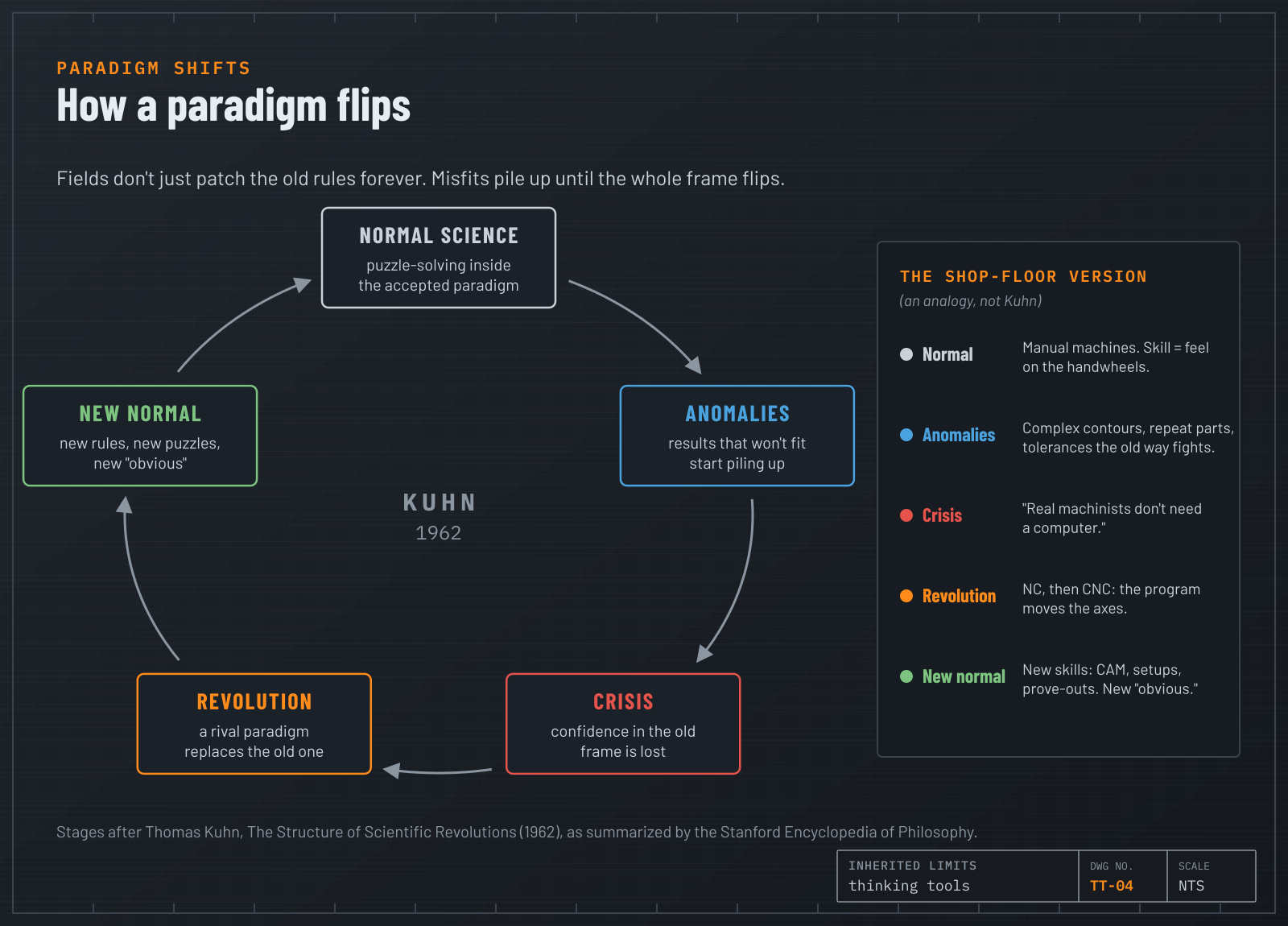
Fields run on shared assumptions. Problems that don't fit pile up, and eventually the whole frame flips instead of getting patched. Habits from the old frame can feel like good practice while holding you back.

Cycle diagram: normal science, anomalies, crisis, revolution, new normal, with a shop-floor analogy panel.
EXERCISE20 min

For one week, keep an anomalies list. Each time something works better than your old rules say it should, write it down. Then ask what unstated assumption the items share.

05

Framing

Who’s who  /  Erving Goffman · George Lakoff

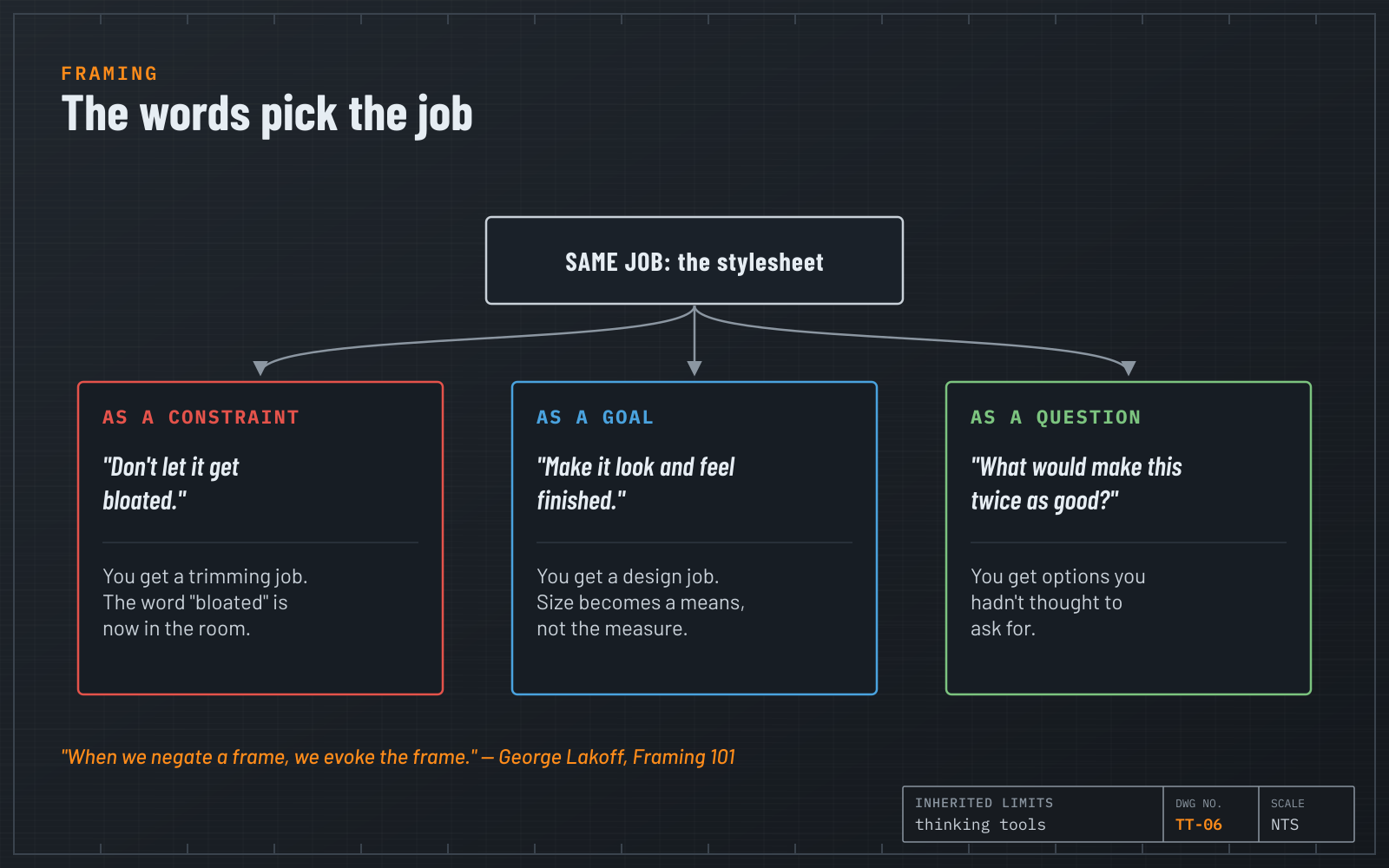
Every situation comes with a frame, a mental setup of what matters. The words you pick decide which answers feel possible. If results feel stuck, change the frame, not the details.

Diagram: one job, the stylesheet, framed three ways: as a constraint, as a goal and as a question, each producing a different kind of work.
EXERCISE15 min

Take a brief you give to a person or an AI. Rewrite it three ways: as a constraint (“don't exceed X”), as a goal (“it should feel Y”), and as a question (“what would make this twice as good?”). Compare what comes back.

06

Wicked Problems

Who’s who  /  Horst Rittel · Melvin Webber

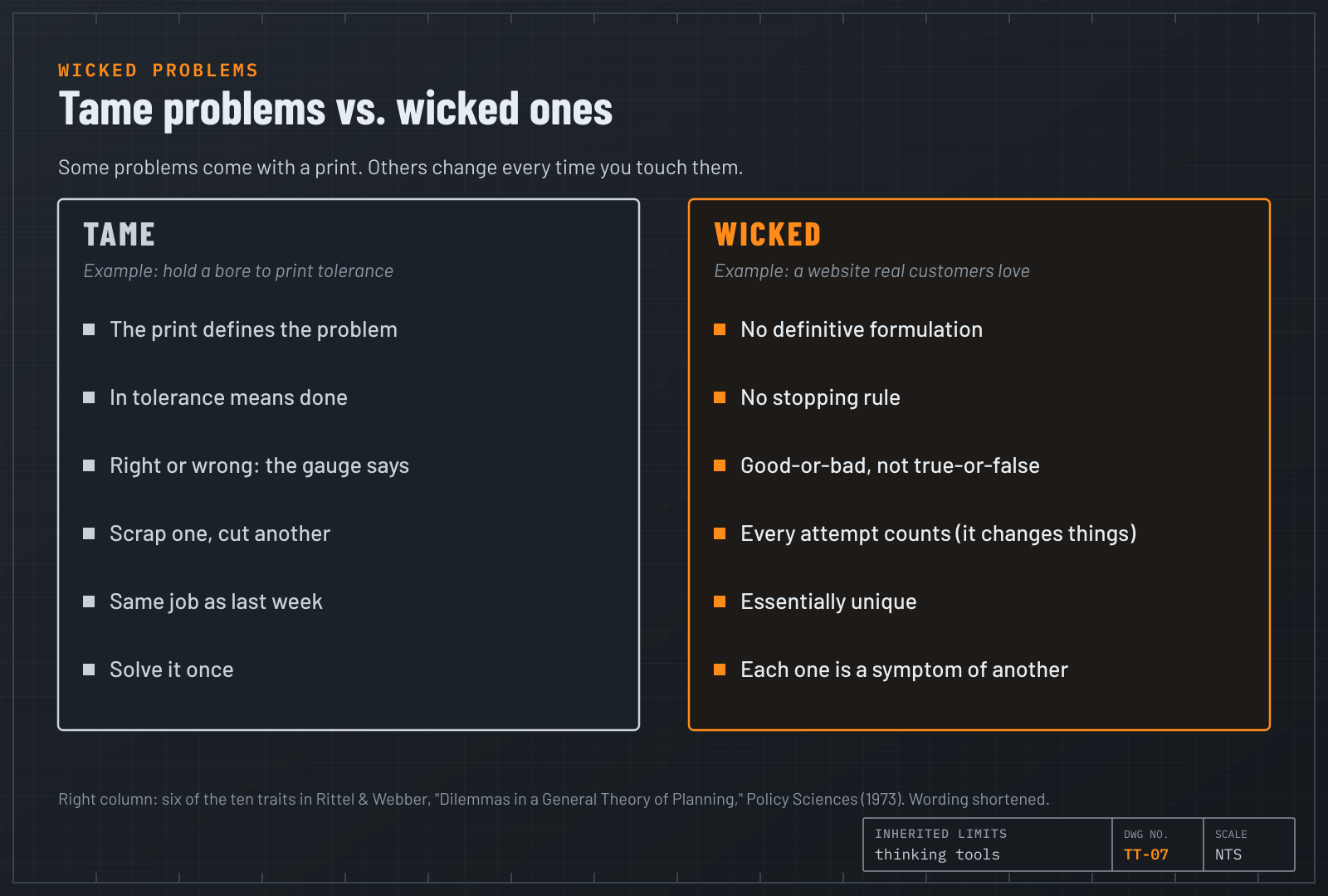
Some problems have no clear definition and no final answer, and every attempt changes the problem. You steer and learn instead of solving once.

EXERCISE20 min

Take one messy question from your work. Write it as a tame problem (clear answer) and again as a wicked one (who is affected, what changes if we act, when would we call it done). Which version fits better?

One habit

The inherited rules audit

At the start of every project, spend 30 minutes listing the rules you're working under, and ask who made each one and why.

  1. 01List the rules and limits. Ask who set each one and why (Double-loop).
  2. 02Map how they connect and feed back (Systems).
  3. 03Notice which belong to an old toolset or paradigm (Paradigm shifts).
  4. 04Reframe the goal (Framing), starting from what is true today (First principles).
  5. 05Expect to revisit it as you learn (Wicked problems).

If you only read two things: the Meadows article, then the Argyris article.